March 2024
Find out more about the exciting research projects currently underway at Woodgreen!
Hi everyone!
This month I thought I’d provide a quick update on everything that is going on in the world of research at Woodgreen. I’ll also start with an apology that there was no February blog, it’s been a busy time for research since Christmas.
Research takes lots of different forms, from short, quick questions and literature searches to significant projects that take more time and collaboration. Deciding on the approach to take usually depends on the questions we have, what the research is for, and how we want to use the findings. Completing larger projects takes time and sometimes it’s a frustratingly slow process, especially when waiting on committees or other bodies to provide the go ahead to get started. Usually, significant groundwork has been undertaken to even reach the point of creating a proposal to begin the research you want to do. This groundwork is worth it though, it means we can be confident that we are taking a robust approach to answering our questions in a practically applicable way.
For those unfamiliar with the process of research, it is also important to receive approval from an ethical review board before you can commence data collection and this process can sometimes take months to complete. An ethical review board will ensure that the planned research protects the welfare of the participants (human and non-human animal), along with ensuring the project is valuable and based on sound scientific principles and methods.
The diagram below demonstrates the stages usually involved in a research process from idea conception to sharing the results – how long these steps take depends on the type of project.

Here are a few of the projects which are underway at the moment.
Perceptions of pre-acquisition practices and expected care investment for different pet species – staff and volunteer project
Current stage: Write up
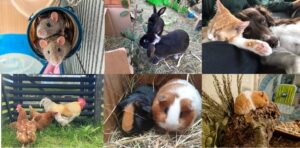
Firstly, a big thank you to everyone who participated in the survey shared in December to capture the views of Team Woodgreen relating to seven of the species that we care for as an organisation. We had a great response as 264 staff and volunteers completed the survey, with a split of 47% staff and 53% volunteers. The seven species included in this project were dogs, cats, rabbits, guinea pigs, chickens, rats and Syrian hamsters.
One of the aims of this research was to explore whether participants consider it more important to undertake research prior to acquiring a pet of one species than another. Another aim was to explore whether Team Woodgreen considers particular species to be more suitable as a pet for children than others. For both of these questions we also wanted to know whether these views differ between staff and volunteers, and pet services and non-pet services team members. We are all ambassadors for Woodgreen, we speak to the public regularly in many of our roles, and we want to make sure that we’re all aligned and have the latest information to share when people are making important decisions around pet acquisition.
Interestingly, there was a difference in the views about both pre-acquisition research importance and the suitability as a pet for children, between the different species. It was seen as significantly more important to undertake research before getting a dog than it was for all other included species, except rabbits. When it came to views about which pets were more suitable for children, dogs and cats came out on top, whilst rabbits and Syrian hamsters were seen as less suitable.
We also found differences between the views of staff and volunteers for both importance of pre-acquisition research and suitability as a children’s pet, for some of the included species. For example, staff members believed it was more important to undertake research before getting a rabbit than volunteers did. Staff also identified rats and chickens as more suitable children’s pets than volunteers did, whereas volunteers viewed dogs, cats, rabbits, guinea pigs and Syrian hamsters as more suitable children’s pets than staff members.
We will share more about this research over the coming months. All our research is designed to be directly applicable to our activities and to inform the way we work, because we want to make sure we use what we’ve learnt to inform our internal practice and knowledge sharing. We will also write up the project officially for submission to a scientific journal, so that we can share this learning more widely and contribute to decisions about animal-welfare related staff training and how we, as charities, can best facilitate that. The outcomes of this research have supported the idea that it is important for animal welfare organisations such as Woodgreen to take time to understand the views of their teams before developing training to ensure consistent messaging is shared about each species by individuals across the organisation.
Pet care and the law project
Current stage: Data analysis
Through the latter months of last year, work was underway to launch a project investigating pet owner knowledge and perception of the law relating to the care of pets in the UK.
Ethical approval for this project was granted in November 2023, so we could start data collection in December 2023. Data collection has now been completed and the plan is to begin the analysis stage in May this year. We’ve been really fortunate with the support received for this project and can’t wait to get started on analysing the responses of over 2800 owners of dogs, cats, rabbits and Syrian hamsters from across the UK.
This project has set out to explore six research questions, all of which will be key to further informing the work of Woodgreen and the wider companion animal welfare sector in the future:
- What is the awareness of the Animal Welfare Act (AWA) and Five Welfare Needs (FWN) amongst pet owners?
- Does awareness of the AWA and the FWN differ with respondent demographics (i.e. age, gender, pet ownership experience, species of companion animal owned)?
- To what extent does owner knowledge of legal requirements to meet the specific needs of the animal inform their reported care practices?
- Do pet owners consider that it is more important to meet the needs of particular pet species? How does ownership of more than one type of pet affect this?
- Do pet owners perceive there is a hierarchy to the different needs of their pet?
- What do owners perceive are appropriate care practices to meet the needs of their pet?

Community project – Littleport and beyond
Current stage: Pilot study complete, data collection for next project underway
A pilot study allows us to explore and test concepts before diving into a larger project. In a pilot study, it’s often the journey which is more important than the outcome as this experience and knowledge provides a basis upon which to build more involved projects.
It’s been a busy time finishing up a pilot project alongside the community team, focusing on the Littleport area and planning the next steps for 2024. Throughout last year, we undertook multiple pieces of research to help understand the needs of pet owners within the Littleport community, including surveys, interviews and co-creation workshops. This research helped to inform the development and delivery of health and wellbeing checks as part of a pilot intervention to improve the welfare of pets in the community. We have recently shared our approach to the project with attendees at the All-Party Parliamentary Dog Advisory Welfare Group (APDAWG) session on the ‘The State of UK Rescue’ and will be talking about this project at a number of other events this year too including the Association of Dogs and Cats Homes conference and Animal Welfare Research Network annual meeting. More to come on the Littleport project in April’s blog.
The experiences of 2023 have enabled us to develop a framework for the community-based projects in 2024 in a way that is practical and means we’ll learn the most useful information to make sure our projects are impactful and have value for communities and their pets. We’ve recently been taking steps to prepare for the initial research stages for 8 new communities alongside Littleport. Ethical approval to start the research has been confirmed and the survey for pet owners will be shared with each community via various channels this week.
Rabbit acquisition practices
Current stage: Ethical board review
Working in collaboration with the PDSA, Hartpury University and Queens University Belfast, we have just submitted an application for ethical approval to begin analysis of data held by the PDSA relating to rabbit acquisition. Every year when the PDSA carry out their Animal Wellbeing report (PAW) they have more data than they can report on, so they have been looking for organisations to partner with to make more use of the available data. The project will be looking for associations between the below factors relating to rabbit acquisition and care:
- Where the rabbit is acquired from (e.g. pet shop, rescue)
- Pre-acquisition practices (e.g. research, seeking advice)
- Motivation for getting a rabbit (e.g. for children/ not for children)
- Provision of appropriate care and husbandry (e.g. preventative healthcare, companionship, diet, accommodation)
- How informed owners are on the five welfare needs from the Animal Welfare Act
- Owner demographics (e.g. age, gender, household income)
We will use the findings from this project to encourage discussions about rabbit acquisition within the animal welfare sector and wider society, to improve rabbit welfare. We also hope to be able to create targeted messaging for both current and future rabbit owners. We hope to start analysis of the data, which will cover 2018-2023, in the next couple of months.
Rabbit enclosure project
Current stage: Research proposal submitted
Also, on the subject of rabbits, we are currently in the planning stages of a summer project to explore perceptions of rabbit accommodation size, including the 3m x 2m x 1m minimum recommendation from the Good Practice Code for the Welfare of Rabbits. Despite the existence of specific recommendations of a minimum size for accommodation, many pet rabbit owners report providing their rabbit with an enclosure smaller than this. We don’t know why this is, especially as we know that so many rabbit owners want to do the best for their pets. Generally, little is known about public awareness of the recommendation and the perception of the recommended size, which could be a factor in owner decision-making about how they house their pets. Through this project we aim to develop a better understanding of public perceptions of rabbit enclosure sizes via engagement with individuals at community-based events. The findings of this project will tell us about reasons that owners perhaps don’t provide appropriate accommodation for their rabbits, and will inform us about how best to engage with owners about the appropriate care of rabbits and thereby help to improve rabbit welfare.
This project is currently at proposal stage and following on from this we will need to secure ethical approval – we are aiming to start collecting data in the summer of this year. We will be looking for volunteers to support the project by conducting mini-interviews at community events in the local area. If you’re interested in research and would like to take part in a project to help improve the welfare of pet rabbits, please feel free to get in touch.

I hope you’ve enjoyed this update. It’s definitely a busy time for research and we’re really looking forward to being able to share some of our findings with you soon. If you’d like to find out any more about any of the projects included, we’re always happy to talk about them so please reach out. In April’s blog you will be able to find out more about the research carried out as part of the Littleport Community project, including the plans for the next target communities to be supported by Woodgreen.