June 2024
ISAZ conference 2024 - Watch and learn: The value of observing and being with animals
The 33rd International Society for Anthrozoology Conference
This month I’ll be blogging about my trip to the ISAZ conference. I’m writing reflections at the end of each day because there’s so much to take in, and importantly it’s all about people and animals. Whilst the conference covers a huge range of different species, it’s possible to select streams of talks which mean you spend the whole conference hearing about companion animals (pets).
This years conference is at Hartpury University, which makes it extra special for me as it’s the university where my PhD is based, meaning it’s a great opportunity to catch up with academic colleagues as well as networking with new faces.
Day one
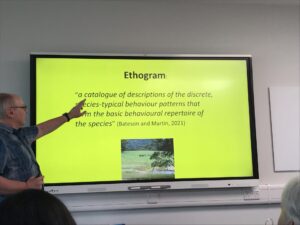
Day one at the ISAZ conference is always an interesting day. It’s full of workshops! Having four days of just talks gets a bit too much for the brain, so the opportunity to engage in discussion on a variety of interesting topics and in some cases contribute to research, is a great way to warm up ready for the main event. This year I filled my morning with a workshop about ethograms and effectively defining behaviour. An ethogram is a list of behaviours shown by a particular species of animal and researchers frequently use them to measure behaviour in a structured way when undertaking research. When designing an ethogram, the idea is that it can be used by anyone to observe the behaviour of an animal, so it should clearly define the behaviours. This isn’t as easy as it sounds however, because many descriptions can ambiguous, meaning that they mean different things to different people. Alternatively if descriptions are too specific it can result in behaviours being unecessarily excluded from results. This workshop was really valuable as we are currently looking into ways to study how different interventions, such as training with an animal, can impact welfare in a rescue centre environment, and ethograms and behavioural observations are one of the key measures often used in this type of research. Outside of an academic setting, ethograms and behavioural definitions can also have practical applications. For example by vets, who may monitor behaviour as a way to monitor health, or within animal care, where owners or handlers may need to look out for specific behaviours of note.
The afternoon of day one led to some fantastic discussions about the impact of early experiences on canine and feline behaviour. It was really interesting to hear the reflections of attendees from across the world on socialisation practices where they live. In truth, lots of the concerns and worries that we have in the UK, seem to be mirrored in other countries. The aim of this workshop was to discuss examples of standardised checklists for socialisation which have been published in the scientific literature and to critically reflect on them to see if there were gaps which should be considered in future research. This workshop was run by a team from Sweden who are looking at taking this research further to consider the development of toolkits for breeders and rescue centres to use. There was lots of agreement that whilst this could be beneficial, there was also a huge need to consider the learning that owners would need to do to ensure that they can read the emotions of their pets and act accordingly to limit negative experiences. Essentially a bit of a guide would be great but a completely one size fits all approach wouldn’t be appropriate as each individual animal will respond differently.
Day two
Day two is packed with talks about different types of human-animal interaction. In addition to the talks, it’s the opportunities to network which really bring value to events like these, and today that starts at breakfast. At last year’s ISAZ conference, I met Carol Tinga, from the University of Guelph, Canada and we got chatting over our interest in rabbit welfare. This year we were able to meet up again and it was amazing to hear about Carol’s research developing a human-animal interaction scale for use with companion rabbits. The networking continued at lunchtime and it was great to spend time with the team from the Dogs Trust talking about their work around relinquishment and acquisition. Networking at research events can be so beneficial and is often a way to discover future collaborations.
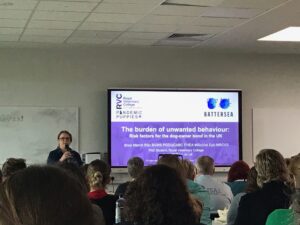
From new faces, to those we already know well, I was fortunate to be able to hear Bree Merritt (previously a Woodgreen vet) give a talk on her Masters project, for which she actually won a conference award. Bree’s work looks at the burden of unwanted behaviour and the risk factors for the dog-owner bond, by exploring the impact of dog behaviour on the owners perceived cost of dog ownership (not just financial) and their perceived emotional closeness to their dog. For anyone who is interested, these factors are measured using scales from the Monash Dog-Owner Relationship Scale (MDORS). Bree and team found that many of the risk factors for increased perceived costs were problematic behaviours and multiple aggressive behaviours were a behavioural risk factor for reduced closeness. As many of you will know Bree has now moved on to study for a PhD looking at online dog relinquishment and I will share updates of her research when I am able to. Bree also says hi to everyone!
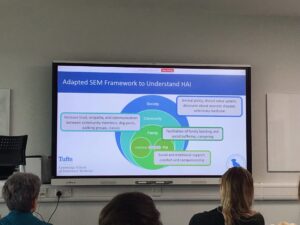
In the afternoon there were several talks about the impact of pets on both individuals and the community. Dr Zoe Belshaw reported that whilst dogs were important in reducing children’s loneliness during lockdown, this wasn’t the same for everyone in the family nor did it stay constant over time. In another talk, focussed on pets and social cohesion, we looked at how pets are integrated at different levels of the socio-ecological model, and looked at an adapted model including the individual and pet, family, community and society. It was interesting to find out that pets did not increase family cohesion but seemed to increase social cohesion at a community level, which led to interesting discussions considering that pets can also be a cause for conflict in a community due to fouling, bites and poor management of behaviour.
The day ended with a keynote talk by Hal Herzog. Many of you may have seen the blog I wrote last year about Dr Herzog’s book ‘Some we love, some we hate, some we eat’. I really enjoyed the book so it was fantastic to be able to see Dr Herzog speak in person about the challenges with the ‘pet effect’. You will often hear people and the media say that pets are good for you, and many of us would probably agree, but strangely the science doesn’t actually support this. Whilst there are a few studies which have demonstrated the benefits of pets (mainly to physical health), there are many more which find either no effect or even a negative effect. Most of us who have pets in our lives, would likely say our pets help us to feel better, and Dr Herzog agrees from his own personal experience but does not believe there is sufficient scientific evidence to continue to state this. The topic led to interesting discussions given that events like the ISAZ conference are often sponsored by the pet industry, who continue to market pets as good for health and mental wellbeing despite very limited evidence to that effect. There are definite conflicts of interest here, and it will be interesting to see how this pans out over the coming years.
Day three
Day three began with a keynote speech from Dr Clara Mancini on the topic of animal-computer interaction. This was a topic that was quite new to me and it was really interesting to hear about the subject of co-design with animals. Dr Mancini has been working on various projects involving different species including designing interactive enclosures for tigers in a sanctuary and working with medical detection dogs. The project with medical detection dogs has focussed on designed tools that are more functional for the dogs to aid their owners. Examples of the way in which this has been applied are push buttons to open doors/ turn on lights which the dogs prefer to use. They have also been designing an alarm which the dog can use to call for help if their person becomes unresponsive and to do this they’ve been testing different types of tuggy as a pull cord to find out dog preferences.
Following on from this I went into a session about emerging topics, which are talks focussing on new projects that researchers are about to start and are looking for input on from their research peers. One of the talks was focussed on cat owners wilingness to mitigate wildlife predation through a variety of different methods. The methods they will be considering include containment, collar items and more natural methods like high protein meals and play periods. They will be sharing a survey later this year across social media so watch out for this popping up in your news feeds.
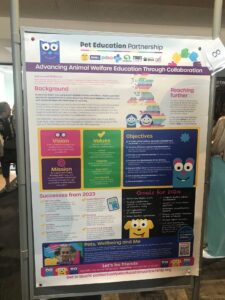
In a couple of other talks, the focus was on DAVE (Dog assisted virtual environment) from the University of Liverpool. DAVE is a virtual reality dog designed by Professor Carri Westgarths research group and sponsored by the Dogs trust. At the moment DAVE has been tested to prove the concept that VR experiences could be beneficial to use in the dog bite prevention space, but the next step are to look at designing interventions to help with education in how to read dog body language and avoid being bitten. In the poster session I was able to catch up with other members of the Pet Education Partnership and see how fantastic the poster about the collaboration was looking. The team seemed to be really busy talking to other attendees so it seemed to generate plenty of interest and discussion.
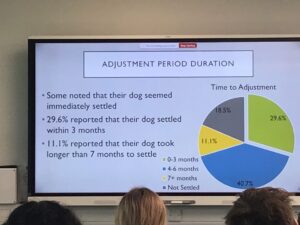
The sessions in the afternoon on shelters and rescue and canine culture. These streams included talks about dog sociability, monitoring cat stress through urine output, raw feeding practices and adjustment periods for rescue dogs recently rehomed. The project looking at dogs settling into new homes is run by the University of Lincoln and although it’s early days the results are suggesting that a period of follow up beyond the traditional 3 days, 3 weeks, 3 months might be appropriate.
Day four
The final day was a morning workshop focussed on qualitative research methods. Qualitative methods move away from traditional numbers and statistics to focus more on the experiences of the participants. Usually these means you’re looking to find out the why behind particular perceptions or behaviours. There are many ways to explore research questions qualitatively and we are just starting to bring more of these methods into our research at Woodgreen meaning the workshop was really beneficial.
I hope you’ve enjoyed this months blog. Obviously I’ve only been able to lightly cover all the wonderful topics discussed at ISAZ so if you would like to hear more, please don’t hesitate to get in touch.