July 2023
This month find out about some of the fascinating talks at the International Society for Anthrozoology conference 2023!
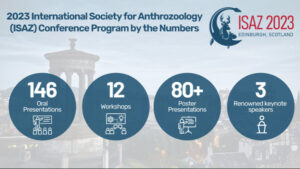
As promised this month’s blog will introduce you to some of the interesting topics and studies which were discussed at the International Society for Anthrozoology (ISAZ) conference last month. ISAZ is an organisation supporting the scientific and scholarly study of Anthrozoology (the study of human-animal interactions and relationships). Historically the focus of human-animal interaction research has been the human side of interactions, particularly looking at the benefits for people, but the future is aiming to have a much greater focus on the animal. The conference was hosted by the University of Edinburgh and was attended by 260 attendees from around the globe including researchers, students and others with an interest in Anthrozoology.
Of particular interest to me was a morning of talks relating to shelter pets and pet adoption, with everything from hoarding to home-to-home rehoming to fostering and imported rescue dogs discussed. One of the standout presentations related to a study by PhD student Lexis Ly looking at the outcomes of online self-rehoming in North America as a potential way to divert pets away from over-stretched rescues. It’s an interesting topic and one that opens debate amongst animal welfare organisations about whether this is a responsible thing to do or not, however when rescues are full and already have waiting lists, pet owners will, of course, be looking for alternative ways to relinquish. The researchers found that 87% of dogs and 86% of cats that were advertised on an online pet-selling site were successfully diverted away from being relinquished to a rescue, with diversion defined as being kept by their original owner or adopted directly by a new owner. Compared to puppies, older dogs were less likely to be successfully diverted away from a rescue and both morphological and behavioural characteristics were important to predicting the success of diversion too. For dogs, this provides some support for our experience that rescues are more likely to end up with dogs that are more challenging to rehome. For cats, behavioural characteristics were less important. Owners who had longer deadlines in terms of when they needed to rehome their pet were more likely to keep or successfully rehouse their pet. If you’d like to know more about this work, the research team have recently published their paper here.
The next session was full of presentations on human-cat interactions. It included topics like the impact of play on cat quality of life and human-cat relationships, and considering what cats would want using individual perspectives. Both of these talks were fascinating, but the one that stuck with me was by Christine Krouzecky who explored the ‘pet-effect paradox’. This paradox is the mismatch between pet owners’ beliefs that our pets make our lives better and the research which regularly suggests things might not be as clear cut when it comes to the impact of pets on our lives. One potential explanation for this is that there seems to be a difference in the answers we give about our experiences with pets depending on how the questions are asked. If we’re given options to choose from, we’ll generally be positive or neutral about our experiences but if we’re asked to answer in our own words, in a more expansive way, the answers tend to be less favourable. The other key factor to consider is the type of interaction with a pet and this has been coined the ‘Aunty Phenomenon’. The premise is that short-term interactions with little responsibility are generally positive experiences, but when those interactions become longer-term with more responsibility, we feel more stress and therefore view the effect less positively. As an Aunty myself, this really resonated with me and might go some way to explaining why there is such variance in the pet ownership experiences reported in the research. Want to know more? This blog by Hal Herzog is an interesting read.
At the end of the second day, there was a poster presentation session. For those who are not familiar with academic posters, they do not adhere to most things you might have learned about effective poster presentation at school. They’re packed with information, but the point is that you have the time to read them, and they’re always accompanied by their author to enable you to ask any questions. There were a couple of posters which really related to the work we do at Woodgreen and interestingly both studies were either undertaken or funded by the Dogs Trust. One of those studies investigated the experiences of dog fosterers, with the aim of refining fostering practices and increasing fosterer satisfaction. The study was interview-based and looked for reoccurring themes in the experiences of fosterers. One of the main themes, and the one presented on the poster was ‘It’s like looking after someone else’s kids’. This theme was underpinned by 3 sub-themes, the first being consistency of care. Essentially fosterers were very mindful of the fact that the dogs in their care had a previous history and would have a future beyond their home and they wanted the transitions to be smooth for them. The second sub-theme centred around the dog still being a Dog’s Trust dog and the implications this had on the way the fosterers cared for the dog and felt about the responsibility. Conflicting perspectives was the final sub-theme and this focused on foster carers really getting to know the dog and not always agreeing with the eventual new home that they were matched with. You can view the full poster here.
The second poster was titled ‘The trouble with a cuddle’ and looked at interactions between children and their family dogs. The take-home message from the study was that families experienced their dog exhibiting aggression or avoidance when close physical contact was initiated by the child, but such observations did not always lead to the child or caregiver ceasing the interaction. What was interesting about this study is that it raises questions about the efficacy of educating children to recognise dog body language to change their behaviour. If children are already aware that their dog may not be enjoying the interaction and still do not end the interaction, another approach may be warranted. You can view the full poster here.

Day 3 began with Bree Merritt and Rowena Packer presenting some of the planned work from the RVC around pandemic puppies. I can’t wait to see this develop further and hope Bree keeps us updated as her PhD gets started later this year. It was also great to see representatives of the Pet Education Partnership presenting a poster on the collaboration between several charities aimed at improving animal welfare education for 7–11-year-olds. It was lovely to meet colleagues from other welfare organisations in attendance including Blue Cross, Dogs Trust, RSPCA and PDSA.
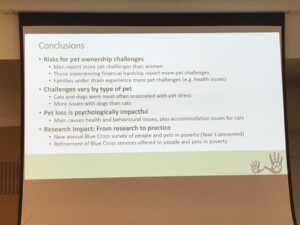
The obvious session to attend after this was focused on the ‘Benefits and Challenges of Pet Ownership’. The Blue Cross have collaborated with the University of Edinburgh to undertake a piece of work titled ‘The nature and impact of challenges currently experienced by pet owners in the UK’. The study suggested that apart from health-related issues, dogs scored higher on challenges than cats. Generally, pet owners with higher attachment to their pets reported fewer challenges, except in the case of financial concerns/stress. Owner gender and circumstances are associated with the risk of reporting pet ownership challenges, with more pet ownership challenges reported by males and those experiencing financial or health issues. The top reasons that dog owners gave for having to give up their dog related to pet health issues (44.1%) and behaviour issues (33.8%), whereas for cats the top reasons were pet health issues (40.8%) and accommodation issues (26.5%). The Blue Cross plan to publish this work and repeat an annual survey of people and pets in poverty, so I will share more information when it is available.
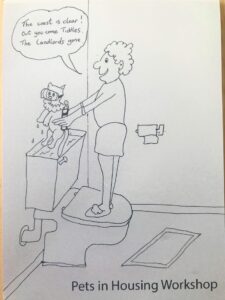
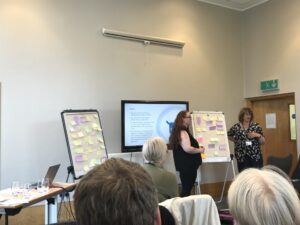
On the final day, I took part in a workshop titled ‘Pets and Housing: Global Challenges and Solutions’. The workshop was led by Elizabeth Ormerod who is chair of the Society for Companion Animal Studies (SCAS) and was held with the aim of assisting SCAS with the initial stages of gap analysis to support the Pets and Housing Steering Group. Their plan is to set up an international working group to help tackle the problems around the lack of pet-friendly housing. The workshop provided a fascinating insight into the challenges faced across the world, many of which are very similar to those we experience in the UK but each with their own cultural differences, particularly when it comes to things like breed bans.
Thank you for taking the time to read this month’s blog, I hope you found it interesting. I could have written so much more about the fascinating conversations and presentations throughout this conference, but I can only fit so much into something that doesn’t then become an encyclopedia. If you have any questions or want to know more about some of the most current research coming out of the conference, feel free to get in touch. I’ve also added a few more items to the Insights Hub this month so remember to have a look around to see what’s there!
Next month, I’ll share a couple of books I’ve been reading recently that really get the brain working when it comes to thinking about animals and the way we treat and care for them.