December 2023
Guest blog introducing Fiona Cooke (Head of Specialist Services) and talking all things research!
Hello, I think many of us have met now, and I’m looking forward to meeting many more of you over the coming weeks. This month, I’m taking over Nat’s blog with an intro and a bit about why I’m so passionate about research. I was delighted to start my role as Head of Specialist Services in October as I’ve always admired Woodgreen and I wanted to be part of the exciting future of the charity! It’s been an amazing first few months, I’ve met so many inspirational people and fantastic pets already. I’m excited about the direction of Woodgreen and the part we will all play in driving the strategy forward. The Specialist Services team brings together the BaTs, Surgery and Research teams. Today, I’m going to focus on research – what it is, why it matters and how we can use it to make a difference for pets and people.
Research is all about being curious, being open to new ideas and having questions; in fact, asking questions is how I ended up working in research! We all naturally learn by asking questions – if you’ve ever spent more than 5 minutes with a toddler, you’ll be very aware of this way of progressing our understanding about the world! This natural curiosity can serve us well throughout life; research provides a way of asking why and problem-solving, with a systematic and structured approach to answering questions. By taking a structured approach to answering these questions, the evidence we discover means we can make the best decisions possible based on what we know – in our case for pets and their people.
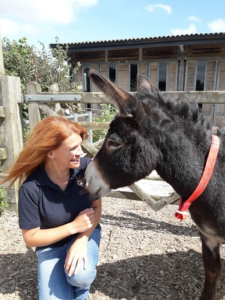
Asking ‘why’ about the rescue dogs we trained when I was working at Hearing Dogs for Deaf People led to me studying law and policy with the aim to help animals before they reached rescue – and taught me an awful lot about the importance of the animal-human relationship. A significant piece of early research I did involved figuring out which lecturers were sneaking dogs into offices so I knew they’d be more receptive to my animal-focused project ideas! Along the way in my studies, I realised that there’s often a disconnect between policymakers and practice, so I studied clinical animal welfare and behaviour science and qualified as a clinical animal behaviourist alongside my job at Blue Cross. But I still had a lot of questions! To explore some more questions, I did a PhD in law, focusing on animal welfare law, policy and enforcement alongside my roles in animal welfare charities, and worked with various government Committees and groups to influence law and policy change. Most recently I worked at The Donkey Sanctuary, leading the Global research teams and ecology team. The role provided an incredible insight into the interdependence of animals and people within communities around the world, and my research focused on working equids in various contexts and on identifying best practice for management and care of equines in shelter environments.
Why is research important?
I am so passionate about the value of research because a scientific approach helps in so many areas of work. It provides a clear structure, allows us to be objective and give us a robust, repeatable framework to ask questions, understand challenges and opportunities, and measure change. Research takes so many different forms; ranging from the research that we might do if we’re looking at buying a new washing machine to massive multi-year projects across universities. The main thing is that all research starts with a question and a desire for knowledge. Then what we do with that knowledge is what actually matters – knowing things is only useful if we put that learning into practice.
One of the core elements of good research is to be very clear what we want to know. And for organisations to keep a really clear focus on the why – if we know the answer to this question that we’re interested in, why will it matter? What does it mean for pets and their people? If we can confidently say that knowing this new thing will improve the lives of pets and their people, improve knowledge in animal welfare or improve what we do every day, helping us to direct our resources in the most effective way, then that’s a good reason to explore the idea further. So, for Woodgreen, all our research has to be clearly aligned with our organisational strategy. Focusing on the impact of the research helps prioritise what we do.
Evidence-led decision-making is also incredibly important for influencing others about how we can improve animal welfare. When we have reliable evidence, we can be confident that we’re making the best decisions for pets in our care and advocating effectively for animals. Sharing and publishing our research helps to build our profile and reach a wide audience – journal papers and conference talks can be picked up around the world, broadening our audience, building our credibility and reaching professionals, pet owners and policymakers.
Another thing that research does is remind us to question what we think and why. It’s great at helping to identify when something isn’t working, and when to say so. It’s not a failure to decide an approach hasn’t worked, but we should use that learning to make informed decisions about our next steps. Research is a great tool for encouraging reflective thinking and constructively developing our insight into our own, and others’, assumptions.
Upcoming plans for research at Woodgreen
Research is only useful to pets if the findings are applied practically; as an organisation we are committed to implementing change and raising welfare standards for pets and finding ways to support people with their pets based upon a sound understanding of the issues. Research allows us to monitor and evaluate our programs of work, ensuring that we are providing impactful and cost-effective support for pets and people needing our help.
Nat is currently working away on her PhD looking at the application of a behavioural prediction theory to understand and change pet owner behaviour, and you’ll be seeing more pieces of research arising from this over the coming weeks and months.
We also have some fantastic collaborative projects in motion at the moment – working with organisations including PDSA, Blue Cross, RSPCA, Dogs Trust and universities to understand more about rabbit owner decision-making and care and children’s interactions with pets. These projects are focused on understanding the practical issues that impact pet welfare, and will be incredibly useful in guiding messaging, support for owners and acquisition information to keep more pets in their homes.

We’ve got some great internal projects going on too – such as working alongside our Community Programmes and Partnerships team to understand the most effective ways of supporting pets and owners in their homes, understand owner perceptions of pet welfare needs, creating a tool for understanding animal experiences and many more!
It’s an exciting time for research at Woodgreen, and we are hoping that many of our teams will have the opportunity to be involved in projects as we progress. In fact, here’s a project that you can become involved in right now – we’re hoping to understand perceptions of the importance of pre-acquisition planning and expected care investment of different pet species amongst our staff and volunteers. Take part by completing our short survey, which can be found here.
If anyone would like to know more about our plans for research just speak to Nat or myself, or join us at our lunchtime learning session – coming soon!